
Watch a YouTube video on Beneficial Nematodes
What are beneficial entomopathogenic nematodes?
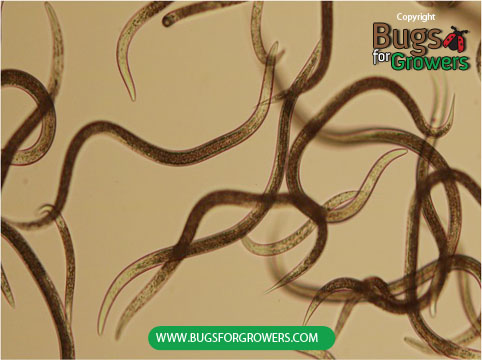
Beneficial entomopathogenic nematodes (EPNs) form a mutualistic relationship with insect-killing symbiotic bacteria. Together, they infect and rapidly kill a wide range of insect pests. Beneficial nematodes naturally present in soils worldwide and help to regulate populations of insect pests. Over the past 30–40 years, they have become commercially available as environmentally friendly biological control agents for controlling agriculture, horticulture, turfgrass, and ornamental crop posts.

Unlike chemical pesticides, EPNs are:
- Safe for humans and animals
- Non-toxic to plants
- Harmless to pollinators such as honeybees
- Environmentally friendly
- Compatible with Integrated Pest Management (IPM) programs
Symbiotic bacteria associated with EPNs
The effectiveness of entomopathogenic nematodes (EPNs) depends on their symbiotic bacteria. The two main EPN genera, Steinernema and Heterorhabditis, carry symbiotic bacteria of the genera Xenorhabdus and Photorhabdus, respectively. These Gram-negative bacteria reside inside infective juveniles and are released into the insect’s body following infection. Inside the insect, the bacteria rapidly multiply, produce toxins and cause septicemia that kill the host insects within 24–48 hours. Within the insect cadaver, these symbiotic bacteria suppress competing microorganisms by producing antibiotics and create favorable conditions for nematode development. A unique feature of Photorhabdus species is their ability to produce bioluminescence under certain conditions.
Life cycle of entomopathogenic nematodes
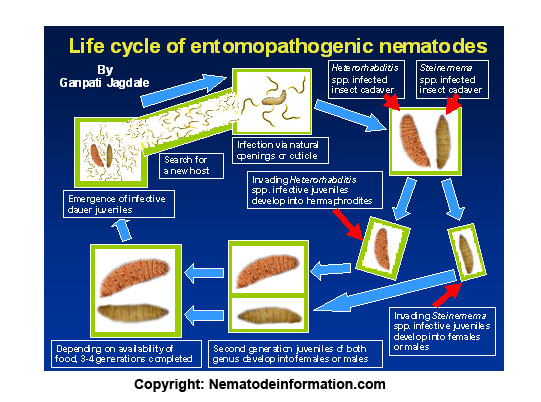
Most of the EPN life cycle occurs inside an infected insect host (Photo 3). The life cycle begins when infective juveniles locate a susceptible insect pest and enter through natural openings, such as the mouth, spiracles, or anus, or, in some Heterorhabditis species, directly through the cuticle. Once inside the insect’s body cavity, the nematodes release their symbiotic bacteria into the insect’s blood (haemolymph). The bacteria then multiply rapidly, cause septicemia and kill the insect within 24–48 hours. The nematodes feed on the bacteria and host tissues, and two to three generations develop inside the insect cadaver. Once the nematodes sense a shortage of food, thousands of new infective juveniles emerge into the soil to search for new hosts. Under optimal conditions (25–30°C), the complete life cycle usually takes 12–15 days.
How do EPNs find their hosts?
Different EPN species use different foraging strategies.
1. Ambush foragers
Species such as Steinernema carpocapsae are called ambush foragers because they wait near the soil surface to infect passing insects. These nematodes are highly effective against:
- Cutworms
- Armyworms
- Sod webworms
- Mole crickets
- Billbugs
2. Cruiser foragers
Species including Heterorhabditis bacteriophora, H. megidis, and Steinernema glaseri called cruisers because they actively move through the soil profile searching for host insects. These nematodes are particularly effective against:
- White grubs
- Black vine weevil larvae
- Other soil-dwelling insects
3. Intermediate foragers
Species such as Steinernema feltiae and S. riobrave called intermediate foragers because they combine ambush and cruising behaviors to locate and infect insect hosts. Both of these nematode species successfully control pests including:
- Fungus gnats
- Mushroom flies
- Corn earworms
- Citrus root weevils
- Mole crickets
How to apply commercially produced beneficial nematodes
- Choose the right nematode for the pest.
Different species work better against different insects. For example, Steinernema feltiae is commonly used against fungus gnat larvae, while Heterorhabditis bacteriophora is often used against white grubs. - Pre-water the soil.
The soil should be moist but not waterlogged. Moisture is essential for nematode movement. - Mix the nematodes in cool/ slightly warm water.
Follow the product’s label for the exact number of nematodes, water volume and area to be treated. Keep the mixture gently agitated because the nematodes settle quickly. - Apply with a watering can, backpack sprayer, or irrigation system.
They can generally pass through normal spray equipment, but avoid very fine filters/nozzles and excessive pressure. - Apply in the evening or early morning.
Direct sunlight/UV can kill nematodes instantly or inactivate them. Soil temperatures are generally best around 55–90°F (13–32°C), although the ideal range depends on the species. - Water lightly after application.
This moves the nematodes into the soil and protects them from drying and UV exposure. Keep the soil consistently moist for several days afterward, but don’t leave standing water. - Target the susceptible stage of the pest.
EPNs are most effective when the insect stage they attack is actually present—for example, larvae/grubs and pupae in the soil.
What are recommended application rates of beneficial nematodes?
The exact rate depends on the target pest, crop, and environmental conditions but for most soil-dwelling insect pests, a general recommendation is:
- 1 billion infective juveniles per acre or 25,000 infective juveniles per square foot.
- Applied in 100–260 gallons (380–985 L) of water per acre.
How do beneficial nematodes work?
Entomopathogenic nematodes are microscopic roundworms that naturally kill insects mainly through a nematode–bacterium partnership:
- Find the insect
- Infective juvenile of Steinernema or Heterorhabditis nematodes move through soil and locate their susceptible insect hosts, often guided by chemicals released by the insect.
- Enter the insect
- The infective juvenile nematodes enter through natural openings such as the mouth, anus and spiracles (breathing pores).
- Release symbiotic bacteria
- Once inside, the nematodes release their associated bacteria:
- Steinernema → Xenorhabdus spp.
- Heterorhabditis → Photorhabdus spp.
- Once inside, the nematodes release their associated bacteria:
- Bacteria kill the insect
- The bacteria multiply rapidly in the insect’s body and produce toxins and other compounds that cause septicemia, killing the host, often within 48 hours.
- Nematodes reproduce
- The dead insect (cadaver) becomes a food source. Nematodes feed on the bacteria and degraded insect tissues and reproduce inside the cadaver.
- New infective juveniles emerge
- When resources are depleted, new infective juveniles leave the dead insect and search for additional hosts.
Why are beneficial nematodes excellent biological control agents?
Beneficial entomopathogenic nematodes are widely regarded as one of the safest and most effective biological control tools because they:
- control a broad range of insect pests,
- actively search for hosts in the soil,
- kill insects rapidly within 24–48 hours,
- recycle naturally in the soil,
- are safe for humans, wildlife, livestock, and plants,
- do not harm beneficial insects such as honeybees,
- leave no harmful environmental residues,
- can be mass-produced commercially,
- are compatible with many insecticides and biological products,
- fit well into Integrated Pest Management (IPM) programs, and
- have a very low risk of resistance development.
Because of their excellent safety record, entomopathogenic nematodes are exempt from pesticide registration requirements by the U.S. Environmental Protection Agency (EPA) and several regulatory agencies worldwide.
Conclusion
Entomopathogenic nematodes are among the most effective biological control agents available for managing soil-dwelling insect pests. Chemical cues produced by host insects help nematodes locate and infect their hosts, which they rapidly kill with the help of their symbiotic bacteria. EPNs are safe for humans, pollinators, beneficial organisms, and the environment, making them an increasingly valuable component of Integrated Pest Management (IPM) as demand for sustainable agricultural practices continues to grow.