
Watch YouTube video on a Parasitic Wasp for Controlling Greenhouse Mealybugs!
Watch YouTube Video on Natural Control of Mealybugs!
Introduction
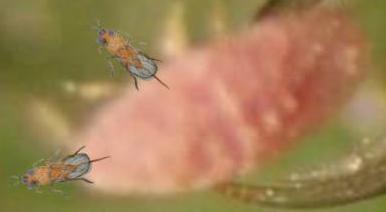
Mealybugs are among the most troublesome pests in greenhouses, ornamental plants, and agricultural crops. They feed on plant sap, weaken plants, cause yellowing and stunted growth. They also produce honeydew that encourages sooty mold development. Fortunately, biological control offers an effective and environmentally friendly solution. One of the most valuable natural enemies of mealybugs is Anagyrus vladimiri, a tiny parasitic wasp widely used to control citrus mealybugs (Planococcus citri) and vine mealybugs (Planococcus ficus) (Photo 1). These beneficial wasps actively search for mealybugs and parasitize them, helping reduce pest populations without relying on conventional chemical pesticides.
What is Anagyrus vladimiri?
Anagyrus vladimiri is a small, endoparasitic wasp belonging to the family Encyrtidae. Female wasps are approximately 1.5–2 mm long, brownish in color, and have distinctive black-and-white banded antennae. Males are smaller, measuring approximately 0.8–0.9 mm, and are black. This parasitoid is effective against several mealybug species, especially citrus mealybug and vine mealybug. It is commercially available and commonly released in greenhouses and agricultural crops as part of integrated pest management (IPM) programs.
How does Anagyrus vladimiri control mealybugs?
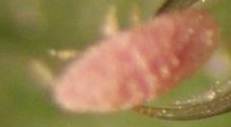
Female Anagyrus vladimiri wasps locate suitable mealybug nymphs and deposit a yellow-colored egg inside the host’s body (Photo 2). The egg hatches into a white larva, which develops internally through five larval stages. During development, the parasitoid larva feeds on the mealybug from inside, eventually killing it. The parasitized mealybug becomes swollen, hardens, and changes into a characteristic golden-brown or orange structure known as a mealybug mummy. The adult wasp develops inside the mummy and eventually emerges by cutting a small exit hole. Newly emerged adults then search for additional mealybugs to parasitize, continuing the biological control cycle. This natural reproductive cycle allows parasitoid populations to establish and provide ongoing suppression of mealybugs under favorable conditions.
Ideal greenhouse conditions for Anagyrus vladimiri
Environmental conditions play an important role in the effectiveness of parasitic wasps. Anagyrus vladimiri can perform across a range of temperatures, with reported activity at approximately 13–14°C (55–57°F) and 35–38°C (95–100°F). However, its optimal performance is generally around 25°C (77°F). These wasps are best suited to greenhouse environments where temperature conditions can be managed. They are not adapted to survive and overwinter outdoors in cold climates, so growers should consider local weather conditions when planning releases.
How to release Anagyrus vladimiri in greenhouses
Correct release timing and placement are essential for successful biological control. Commercially supplied Anagyrus vladimiri wasps are generally shipped as adults.
Follow these practical application guidelines:
- Release promptly: Introduce the wasps into the greenhouse or field as soon as possible after delivery.
- Store carefully: If immediate release is not possible, keep the packages in a cool place away from direct sunlight and follow the supplier’s storage instructions.
- Choose the right time: Release adult wasps early in the morning when temperatures are above 7°C (45°F), or in the evening when temperatures are below 35°C (95°F).
- Release near infestations: Open the containers and allow the adult wasps to emerge naturally while walking slowly through the growing area.
- Use an appropriate release rate: As a preventive measure, approximately 1–2 parasitoid wasps per square meter can be released at the first signs of mealybug infestation, subject to product label and supplier recommendations.
- Repeat applications: Repeat releases over several weeks to improve establishment and increase the chances of successful mealybug suppression.
- Protect beneficial insects: Place release containers in shaded locations near mealybug-infested plants, away from direct sunlight.
An additional important consideration is ant management. Ants often protect honeydew-producing mealybugs from natural enemies in exchange for access to honeydew. Controlling ant activity can therefore improve the effectiveness of parasitoid releases.
Benefits of using Anagyrus vladimiri for biological control
Using Anagyrus vladimiri provides several advantages for greenhouse growers and agricultural producers.
- Effective mealybug suppression: These parasitoids attack important pest species, including citrus and vine mealybugs.
- Natural pest control: They reduce pest populations through biological activity rather than conventional chemical treatments.
- Self-sustaining populations: Under favorable environmental conditions and with sufficient host availability, parasitoids can reproduce and complete multiple generations.
- Easy application: Commercially available wasps can be introduced directly into greenhouses and fields.
- Reduced plant damage: By attacking mealybugs, they help protect plants from sap-feeding damage and associated problems.
Why are parasitic wasps a safer alternative to chemical pesticides?
Biological control using beneficial insects offers an alternative approach to conventional pesticide-based pest management. Unlike chemical insecticides, Anagyrus vladimiri targets mealybugs through natural parasitism. These beneficial wasps do not damage plants and do not leave conventional pesticide residues on crops. Their use can also help reduce pesticide applications and the associated risk of environmental contamination. Because they are beneficial biological control agents rather than chemical pesticides, they can be particularly valuable in greenhouse production systems where reducing pesticide inputs is an important management goal.
Conclusion
Anagyrus vladimiri is a valuable biological control agent for managing greenhouse mealybugs, particularly citrus mealybug and vine mealybug. Its ability to parasitize mealybug nymphs, reproduce under suitable conditions, and provide continuing pest suppression makes it an excellent addition to integrated pest management programs. By releasing these beneficial wasps at the first signs of infestation, maintaining suitable greenhouse temperatures, repeating applications when necessary, and managing ants, growers can achieve more sustainable and environmentally responsible mealybug control. For greenhouse growers looking to reduce chemical pesticide use and protect their crops, Anagyrus vladimiri offers an effective natural solution.